
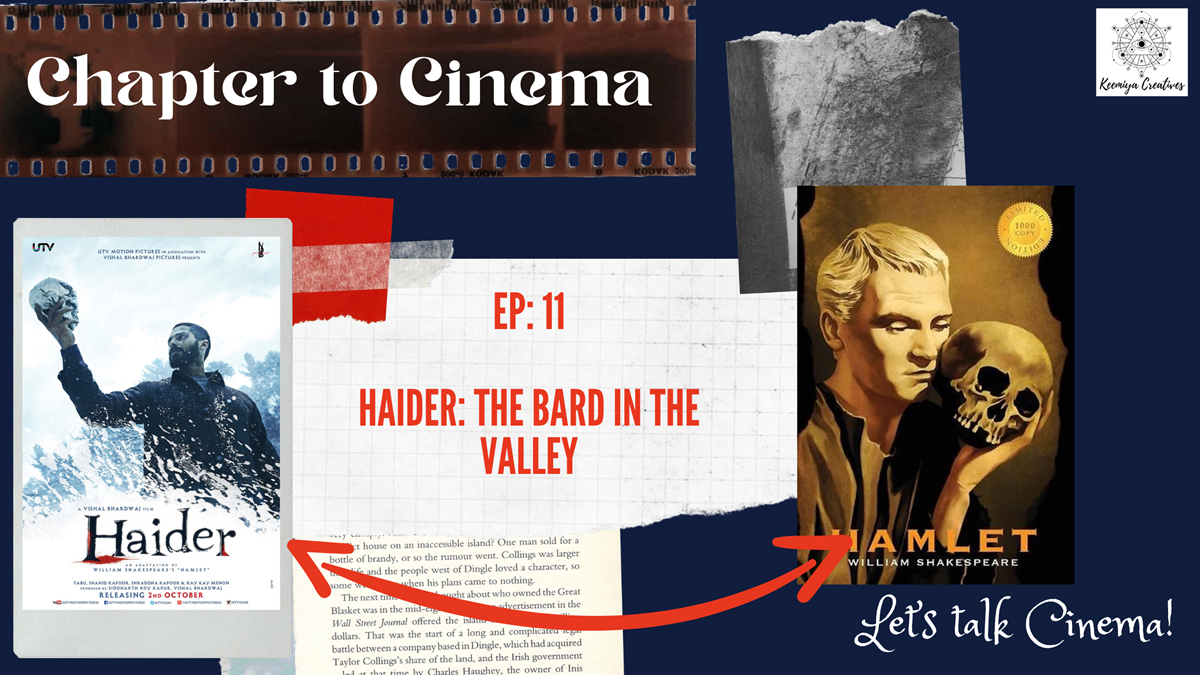
In the latest episode of Chapter to Cinema we analyse Haider movie where Shakespeare Meets Kashmir
Welcome back to Chapter to Cinema, where we unravel the magic of book-to-screen adaptations! This week, we’re diving into Vishal Bhardwaj’s Haider – the 2014 Bollywood masterpiece inspired by William Shakespeare’s Hamlet and Basharat Peer’s Curfewed Nights.
Set against the hauntingly beautiful yet politically charged landscape of Kashmir in the 1990s, Haider movie is more than just a retelling; it’s a visceral experience that reimagines the Prince of Denmark as a conflicted young man searching for truth, vengeance, and closure.
Let’s break down how this adaptation stays loyal to Shakespeare while carving out its own powerful identity.
From Elsinore to Srinagar – A Bold Shift
In Haider movie, Bhardwaj transposes the royal court of Denmark to a snow-clad Kashmir caught in the crossfire of insurgency and military conflict. This shift not only enhances the tension and tragedy of Hamlet but also adds a layer of socio-political commentary that resonates deeply with contemporary audiences.
Shahid Kapoor’s Haider movie mirrors Hamlet’s existential crisis, grappling with the disappearance of his father and the unsettling relationship between his mother Ghazala (Tabu) and uncle Khurram (Kay Kay Menon). The familial betrayal and search for justice unfold against Kashmir’s volatile backdrop, heightening the stakes and emotional depth.

Breaking Down the Adaptation
In this episode, we dissect the brilliant elements that make Haider movie one of the most lauded Shakespearean adaptations in Indian cinema:
- Faithful Yet Fearless: While Haider retains the core plot of Hamlet, it fearlessly adapts the narrative to reflect the socio-political landscape of Kashmir, making it both universal and uniquely Indian.
- Character Adaptations:
- Hamlet → Haider Meer (Shahid Kapoor) – A grief-stricken son who returns to Kashmir to unravel the mystery of his missing father.
- Gertrude → Ghazala (Tabu) – Haider’s enigmatic mother whose ambiguous morality adds a complex layer to the narrative.
- Claudius → Khurram Meer (Kay Kay Menon) – Haider’s uncle, whose lust for power (and Ghazala) mirrors Shakespeare’s villain.
- Ophelia → Arshia (Shraddha Kapoor) – Haider’s love interest, caught in the crossfire of family and political loyalty.
- Cultural Anchoring: Bhardwaj’s decision to frame the story within the Kashmir conflict transforms Haider into more than just a personal tragedy. It reflects the region’s larger struggles, making the film socially relevant while retaining Shakespeare’s universal themes of betrayal and revenge.

What Worked – And What Blew Our Minds
The Hits:
- Powerhouse Performances: Shahid Kapoor delivers his career-best performance as Haider, capturing the madness and melancholy of Hamlet with chilling precision. Tabu’s nuanced portrayal of Ghazala is both haunting and heartbreaking, elevating the adaptation to a whole new level.
- Visual Poetry: From snow-laden graves to haunting vistas of Kashmir, the cinematography adds a surreal, almost theatrical quality to the film.
- Musical Brilliance: The soundtrack, especially Bismil, serves as both narrative and spectacle, artistically representing Hamlet’s famous “play within a play.”
- Political Commentary: Bhardwaj weaves Kashmir’s strife into the very fabric of the narrative, blending personal grief with collective tragedy.
The Misses (If We Can Call Them That):
- Not for the Faint-Hearted: Haider is heavy. Its stark portrayal of violence, loss, and mental breakdowns might not sit well with those expecting lighter fare.
- Complexity Overload: The film’s layered political subtext can feel overwhelming, especially for viewers unfamiliar with the Kashmir conflict or Shakespeare’s original play.
Performances That Stay With You
Tabu as Ghazala is the beating heart of Haider movie. Her morally ambiguous character adds emotional depth, constantly shifting between vulnerability and manipulation.

Kay Kay Menon’s understated menace as Khurram lingers long after the credits roll, while Irrfan Khan’s brief yet impactful cameo as Roohdar (a version of Hamlet’s ghost) is unforgettable.
Read all other episodes of Chapter to Cinema.
Trivia Time!
- Haider marks the third installment in Vishal Bhardwaj’s Shakespeare trilogy, following Maqbool (Macbeth) and Omkara (Othello).
- The Bismil song sequence was filmed at the Martand Sun Temple in Kashmir, a visually stunning backdrop that adds to the film’s theatrical presentation.
- Shahid Kapoor spent weeks preparing for his role, even shaving his head on-screen in one of the film’s most iconic scenes.
Final Verdict – Does Haider Do Hamlet Justice?
Absolutely. Haider movie isn’t just an adaptation—it’s a reinvention. By merging the personal with the political, Bhardwaj creates a gripping narrative that feels both timeless and immediate.
Whether you’re a Shakespeare purist or a lover of hard-hitting cinema, Haider delivers on every front.
Want More Shakespeare in Bollywood?
Catch the full breakdown of Haider in our latest Chapter to Cinema episode! We dive deeper into the symbolism, performances, and the subtle nods to Hamlet that make this film a masterpiece.
Watch the full analysis of Haider on our YouTube channel – Book Talk
What’s Next?
What book-to-screen adaptation should we tackle next? Drop your suggestions in the comments – we love turning Chapter to Cinema!

Leave a Reply