
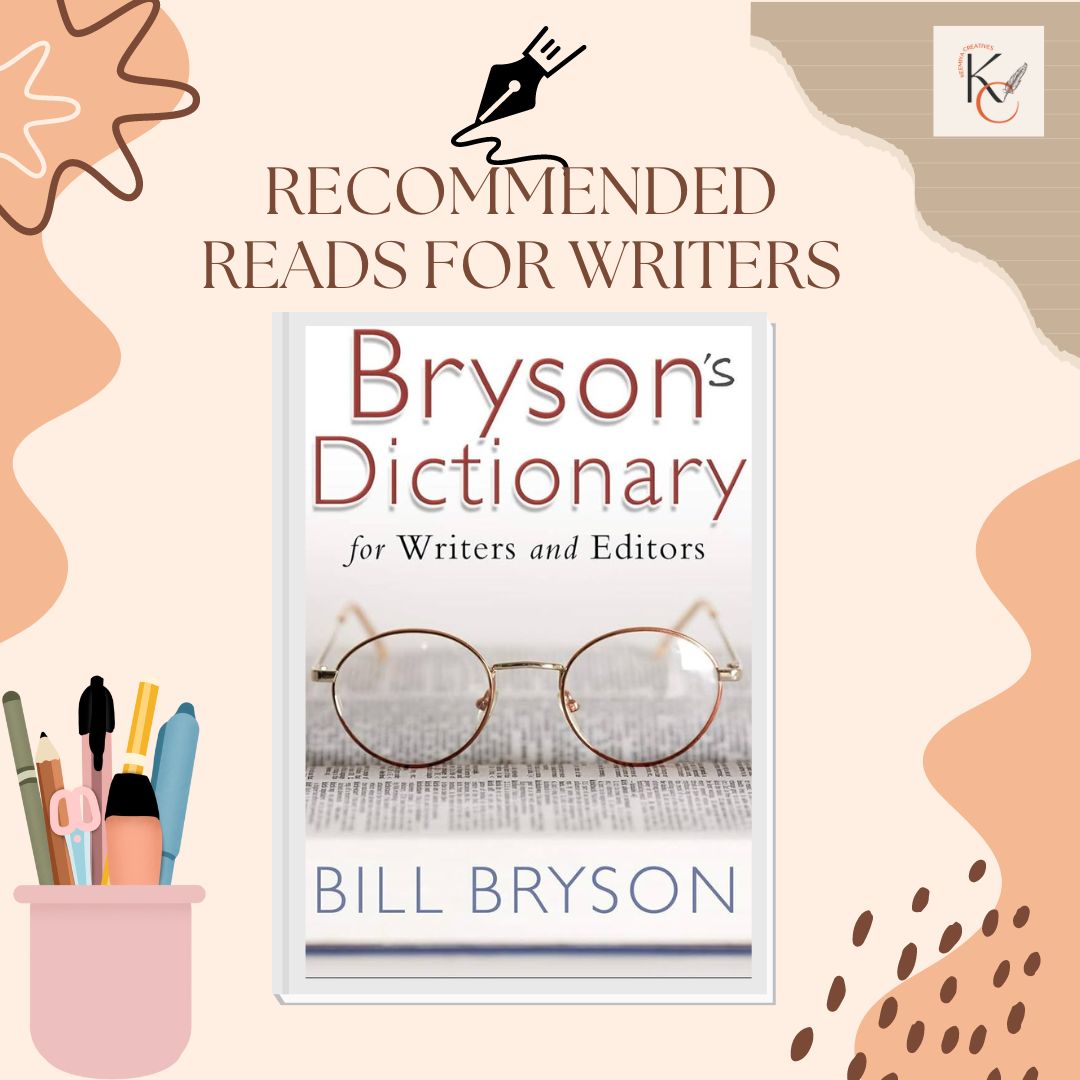
In this segment we recommend books for writers every week. This week’s pick is Bryson’s Dictionary: for Writers and Editors by Bill Bryson.
Bryson’s Dictionary for Writers and Editors is an invaluable resource for anyone involved in writing, editing, or simply seeking to improve their command over the English language.
With its vast collection of words, phrases, and expressions, this dictionary offers much more than a traditional lexicon. It serves as a guide, offering clarity and precision in language usage.
One of the standout features of Bryson’s Dictionary is its user-friendly format. The entries are organized alphabetically, making it easy to navigate and locate specific words or phrases. Each entry provides a concise definition, along with examples of usage, making it simple to understand the word’s meaning and context.
What sets this dictionary apart is its focus on providing context-specific meanings. Whether you’re a writer, editor, or language enthusiast, you’ll appreciate the attention to detail in defining words in relation to specific contexts.

What makes Bryson’s Dictionary truly special is its versatility. It caters not only to writers and editors but also to anyone with an interest in language and communication.
Whether you’re a student, professional, or simply someone who loves words, you’ll find this dictionary to be an indispensable tool. It goes beyond a traditional dictionary, offering insights into language nuances and providing guidance on effective communication.
Read about our first book of Writing Prompts for Beginners
One of the most commendable aspects of Bryson’s Dictionary is its comprehensiveness. It covers a wide range of topics, including grammar, punctuation, style, and usage.
Whether you’re grappling with the intricacies of grammar or seeking guidance on the appropriate usage of a word, you’ll find the answers you need within its pages. The dictionary also includes a wealth of examples, helping to clarify the meaning of words and their usage in different contexts.
Another notable feature of Bryson’s Dictionary is its accessibility. The language used is clear and concise, making it easy to understand even for those with limited linguistic knowledge. Additionally, the dictionary is designed to be user-friendly, with a layout that is intuitive and easy to navigate. Whether you’re a seasoned writer or someone just starting out, you’ll find this dictionary to be an invaluable resource.
In conclusion, Bryson’s Dictionary for Writers and Editors is a must-have for anyone who works with words. Its comprehensive coverage, user-friendly format, and focus on context-specific meanings make it an indispensable tool for writers, editors, and language enthusiasts alike.
Whether you’re writing an essay, editing a manuscript, or simply looking to improve your language skills, this dictionary is sure to become an essential part of your toolkit. With Bryson’s Dictionary by your side, you’ll have the guidance and support you need to communicate effectively and confidently in any situation.
Watch the first episode of season 2 of the Bookbot Theory,our podcast on book-marketing.
About Bill Bryson
Bill Bryson was born in Des Moines, Iowa, in 1951. His bestselling books include The Road to Little Dribbling, Notes from a Small Island, A Walk in the Woods, One Summer and The Life and Times of the Thunderbolt Kid. In a national poll, Notes from a Small Island was voted the book that best represents Britain.
His acclaimed work of popular science, A Short History of Nearly Everything, won the Aventis Prize and the Descartes Prize, and was the biggest selling non-fiction book of its decade in the UK. His new book The Body: A Guide for Occupants was shortlisted for the Royal Society Science Book Prize and is an international bestseller.
Bill Bryson was Chancellor of Durham University 2005-2011. He is an Honorary Fellow of the Royal Society. He lives in England.

Leave a Reply