
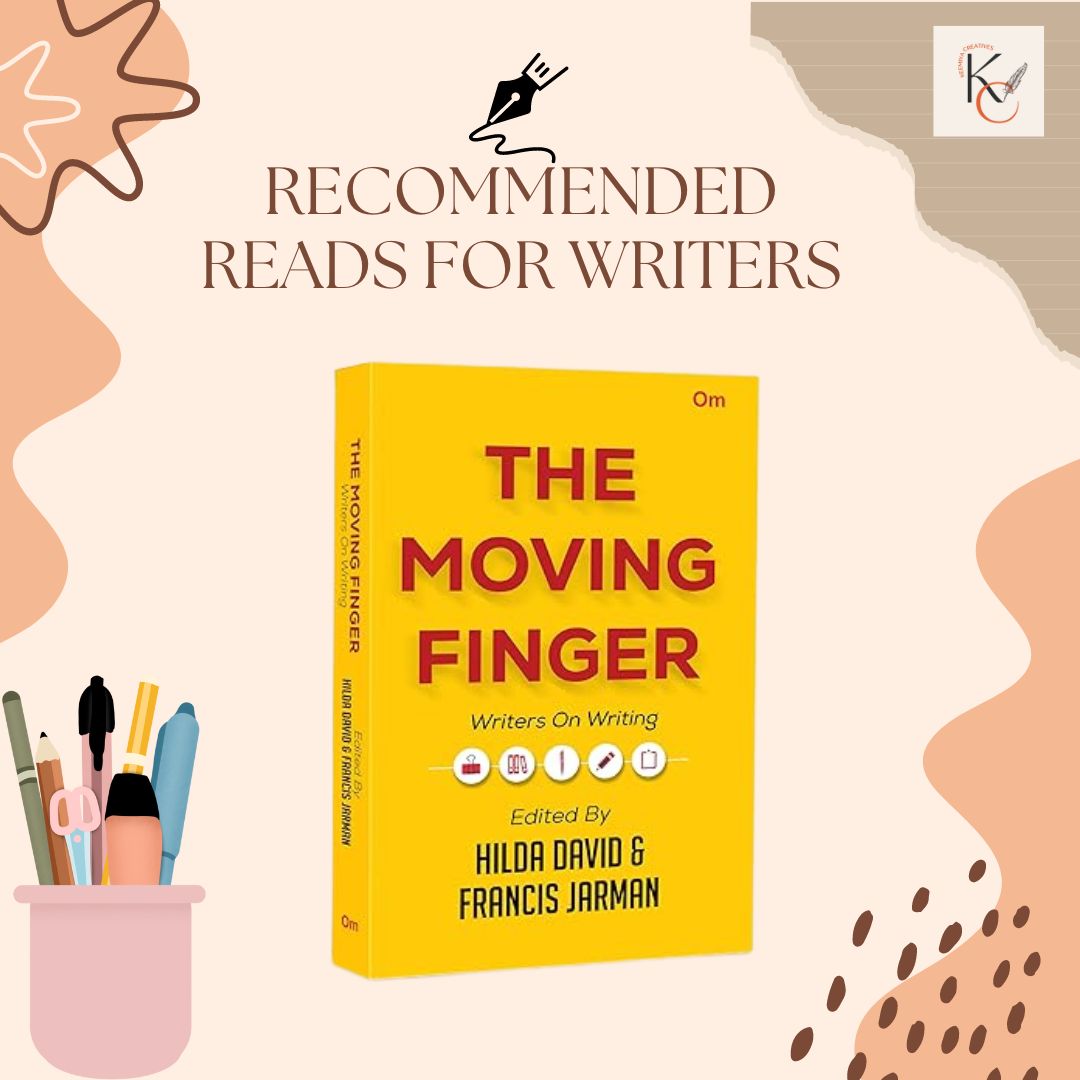
In this segment, we recommend books for writers every week. This week’s pick is The Moving Finger: Writers on Writing.
The Moving Finger: Writers on Writing
The Moving Finger (Published by Om Books International, 2024) is an exceptional anthology that offers readers an intimate glimpse into the minds of some of the most accomplished writers, both Indian and international. This book is a treasure trove of insights for anyone who has ever pondered the why, how, and what of writing, much like Shashi Deshpande herself.
The anthology features twenty-six essays that span a broad spectrum of writing genres, from novelists and poets to dramatists, scriptwriters, humorists, columnists, and translators. These contributors are a mix of renowned award-winners, experienced professionals, and rising stars, making the collection rich and diverse in perspective.
About Moving Fingers
If like Shashi Deshpande you have wondered about the why, how, and what you want to write, here’s a collection of essays that attempts to demystify “that peculiar activity called writing”. With great personal honesty, Indian and international novelists, poets, dramatists, scriptwriters, humorists, columnists, and translators, whether renowned award-winners, experienced professionals, or rising stars of the literary scene, contribute useful (and often surprising) insights into their respective genres.
Be it writing about sex, writing noir, writing about food or for the screen, writing about psychopaths or fantasy fiction, or for children, let those who have been through the agony and the ecstasy, the delights and the pitfalls, guide you. Though there is no one way of writing—a vocation individualistic and idiosyncratic like no other—and each writer will have to find his or her own way, the twenty-six essays in this anthology will provide a roadmap for navigating what Martin Amis describes as a “deeply mysterious process”.
One of the book’s standout qualities is its unflinching honesty. Each writer delves deep into their personal experiences, sharing not just their successes but also the agonies and ecstasies that accompany the creative process. This authenticity provides a comforting reminder that even the most celebrated writers grapple with self-doubt and struggle.

The essays cover a wide array of topics that are both enlightening and often surprising. For instance, readers can explore the nuances of writing about sex, a topic that many find challenging to tackle with the right balance of honesty and sensitivity. Similarly, there are essays on writing noir, where the dark and gritty aspects of storytelling are dissected, and on writing about food, where the sensory details play a pivotal role in evoking vivid imagery.
Particularly fascinating are the essays on niche genres such as writing for children, fantasy fiction, and even psychopaths. These contributions provide valuable guidance on how to approach these unique subjects, each requiring a distinct mindset and set of skills. The essay on screenwriting is another highlight, offering practical tips on crafting compelling narratives for visual media.

Despite the varied subjects, a common thread runs through all the essays: there is no one-size-fits-all approach to writing. Writing is inherently individualistic and idiosyncratic, and each writer must find their own path. This theme resonates throughout the anthology, encouraging readers to embrace their unique voice and style.
One of the most profound takeaways from the book is the understanding that writing is a unique process for each writer.
The essays serve as a roadmap to navigate this mystery, offering guidance, inspiration, and a sense of camaraderie. Whether you’re writing about fantasy worlds or real-life psychopaths, food or noir, the insights provided by these seasoned writers are invaluable.
Read more book recommendations from Team Keemiya for writers.
In conclusion
Moving Fingers is an indispensable resource for writers at any stage of their journey. It demystifies the writing process and provides a wealth of knowledge that can help writers refine their craft.
More importantly, it offers reassurance that the path to becoming a better writer is a personal and often winding one, but one that is richly rewarding. This anthology is not just a guide; it is a companion for anyone who has ever felt the urge to write and seeks to understand the complexities and joys of this peculiar activity.
About the Editor
Hilda David is a novelist, stage director, and teacher. Until retirement, she was a professor of English at the Symbiosis College of Arts and Commerce in Pune, and coordinator of the Centre for Liberal Arts, where she taught Advanced Creative Writing, Literature and the Supernatural, and Crime, Law, and Literature.
Dr David has been a consultant to the Norwegian Ministry of Foreign Affairs, coordinated and organised the Ibsen Festivals in Pune and Delhi, and was chosen by the English Speaking Union to represent India at the Shakespeare Workshop in London in 2008. Her works have been translated into Hindi, Urdu, and Kannada. She is the co- editor, with Francis Jarman, of India Diversity (Om, 2017) and Text Wars (Oxford, 2021).
Francis Jarman is a novelist, playwright, and critic. Until retirement, he taught English, comparative cultural studies, and intercultural communication at Hildesheim University, Germany. He has also taught or lectured at more than twenty other universities, in Europe, Asia, and Africa, including being a scholar in residence at Symbiosis, Pune, and a visiting professor at American College, Madurai. Dr Jarman is the co-editor, with Hilda David, of India Diversity (Om, 2017) and Text Wars (Oxford, 2021). His novels, published by Wildside in the US, include the Lemnos science fiction trilogy (2011–16); the historical fantasy series The Gardens of the West (2015–ongoing), and the campus thriller Cold from Your Breath (2019).
(Disclaimer: Please note this page contains affiliate links.)

Leave a Reply