
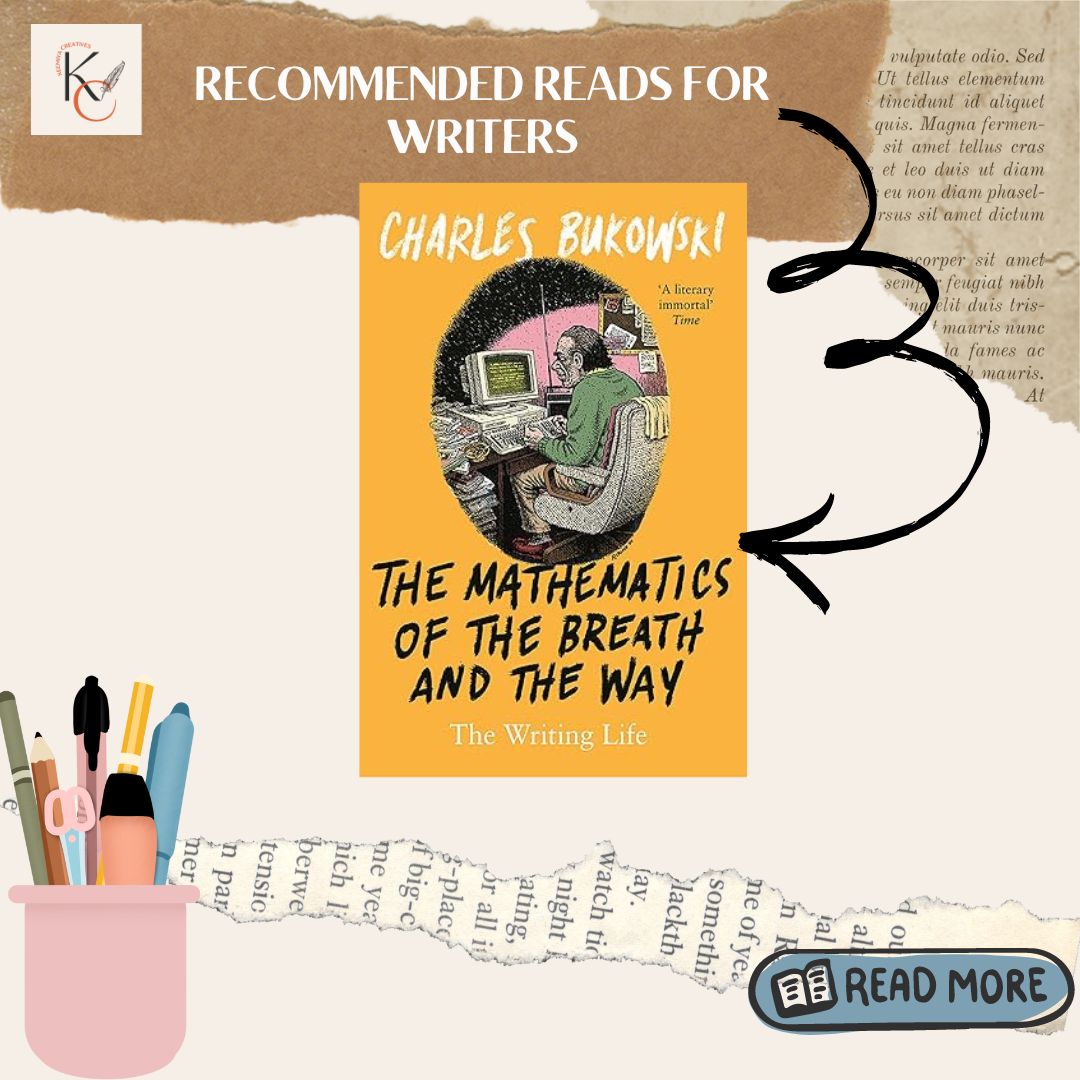
The recommended read for writers this week is The Mathematics of the Breath and the Way: The Writer’s Life (Canongate Books, 2018) by Charles Bukowski.
For those who have ever wondered what it’s like to live the life of a writer—the grit, the grind, and the glory—Charles Bukowski’s The Mathematics of the Breath and the Way offers an unvarnished glimpse into this world.
Charles Bukowski, often known for his tough, no-nonsense approach to life and literature, presents readers with a collection of stories, columns, interviews, and musings that shed light on his writing practices and the life of a writer who wasn’t afraid to strip away pretension and tackle the harsh realities of his craft.
A Guide to the Myth Behind the Man
Bukowski’s writing has always blurred the lines between myth and reality, and in this collection, you get to see both the myth of the hard-living, hard-drinking poet and the reality of a disciplined artist. The Mathematics of the Breath and the Way doesn’t sugarcoat anything—it’s Bukowski at his rawest and most direct, giving readers insights into his chaotic life, his creative process, and his unapologetic worldview.
The book’s title piece, The Mathematics of the Breath and the Way, opens with a manifesto that Bukowski disguises as casual remarks. As he philosophizes on his way to the racetrack, he offers a seemingly off-handed take on the mechanics of writing and the odd alchemy that fuels his creative output. The title alone captures the juxtaposition Bukowski loved to explore—the cold calculation of writing’s technical side with the spontaneous, messy reality of being a writer.
A Glimpse into the Chaos of a Writer’s Life
What sets The Mathematics of the Breath and the Way apart from other books on writing is that it doesn’t come with neat writing tips or motivational clichés. Instead, Bukowski paints a portrait of a writer’s life in all its chaotic glory. Through his stories, we see him navigating poetry readings, bars, and parties, with each setting offering a chance to reflect on the absurdity and unpredictability of both his career and life.
Bukowski’s reflections often highlight how writing wasn’t just something he did—it was how he survived. Armed with his typewriter and a bottle of beer, he took on the world around him, deflating the pretensions of those who idolize the life of a writer without understanding its toll. For Bukowski, writing was gritty, painful, and necessary. He talks about it not as a lofty intellectual pursuit, but as a daily battle fought between bouts of drinking and chain-smoking.
About Charles Bukowski

Charles Bukowski is one of America’s best-known contemporary writers of poetry and prose, and, many would claim, its most influential and imitated poet. He was born in 1920 in Andernach, Germany, to an American soldier father and a German mother, and brought to the United States at the age of three.
He was raised in Los Angeles and lived there for fifty years. He published his first story in 1944 when he was twenty-four and began writing poetry at the age of thirty-five. He died in San Pedro, California, on March 9, 1994, at the age of seventy-three, shortly after completing his last novel, Pulp.
Cynical, Yet Profoundly Insightful
Charles Bukowski’s cynicism runs through every page of this collection, yet his observations are often startlingly insightful. As he tears down the ivory towers of literature and exposes the industry’s pretensions, he offers readers a different kind of truth about writing—one that’s not glamorous or romanticized but deeply rooted in the day-to-day struggles of a working writer.
One of the standout features of the collection is Charles Bukowski’s literary criticism. He offers sharp, unsentimental takes on famous authors and the art of storytelling, with each critique carrying his trademark style—unflinching, irreverent, and brutally honest. His thoughts on what makes a writer “great” are refreshingly free of the usual reverence for literary giants. Instead, he cuts to the heart of why certain books stick with us and others fade into obscurity, all the while keeping his tongue firmly in cheek.

Writing as Survival
What’s fascinating about Bukowski’s approach to writing is that for him, it was more than just a profession—it was a way to survive the chaos of his life. Writing allowed him to process the world’s absurdity, deal with his internal demons, and make sense of the madness that surrounded him. While other writers may romanticize the craft, Bukowski strips it bare, showing the audience that writing, for him, was an act of survival.
This sentiment is echoed in the interviews that close out the book, where Charles Bukowski discusses his writing practices and the influences that shaped his style. For aspiring writers, these interviews are a goldmine, providing a candid glimpse into the mind of a man who wrote not for fame or fortune, but because he had to.
Read more such book recommendations for writers.
A Masterclass in Brutal Honesty
If there’s one takeaway from The Mathematics of the Breath and the Way, it’s that writing, like life, is not about perfection but persistence. Bukowski’s honesty about the writing process—the frustrations, the failures, and the fleeting moments of success—serves as a refreshing reminder that the real art lies in showing up, day after day, even when inspiration feels out of reach.
Writers and readers alike will find themselves drawn to Bukowski’s unsentimental portrayal of what it means to create. He defies the notion that writers must live in ivory towers, instead suggesting that some of the best writing comes from life’s darkest and dirtiest corners. Charles Bukowski’s work is a testament to the power of perseverance and the raw beauty of imperfection.

Final Thoughts
The Mathematics of the Breath and the Way is more than a collection of Bukowski’s musings on writing; it’s a window into his soul. Through stories, interviews, and literary critiques, Charles Bukowski shows us that writing is messy, unpredictable, and often thankless—but it’s also vital, transformative, and worth every ounce of struggle.
Bukowski strips away the glamorous facade of being a writer, replacing it with a hard-earned truth: writing, like life, is about survival. It’s about doing the work, day in and day out, regardless of fame or fortune. For Charles Bukowski, the greatest victory wasn’t in the accolades but in the act of writing itself.
Looking for an unfiltered take on writing and life? Grab a copy of The Mathematics of the Breath and the Way and immerse yourself in Charles Bukowski’s world—raw, real, and unapologetically honest.
Disclaimer: This page contains affiliate links.

Leave a Reply