
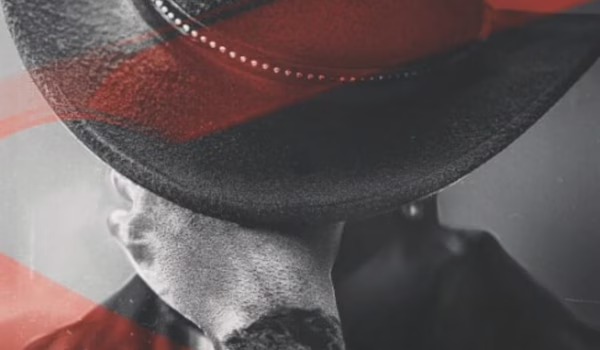
In the latest blogpost, we analyse the controvery around O Romeo by Vishal Bhardwaj and what it means for Indian Writers.
The recent legal dispute surrounding O Romeo by Vishal Bhardwaj, a recently released high‑profile Hindi film widely reported to have drawn inspiration from real‑life personalities has sparked more than just headlines. It has sparked an important conversation in India’s creative community about what writers need to be careful about when writing about real people, real events, or situations that might be identifiable.
While the O Romeo by Vishal Bhardwaj controversy involves cinema and court motions, the underlying concerns are deeply relevant to authors, novelists, memoirists, non‑fiction writers, and anyone attempting to translate reality into narrative.
For Indian writers who worry, “What permissions do I need?” or “Can I be legally pursued for what I write?”, this moment is worth unpacking carefully and clearly.
The O Romeo by Vishal Bhardwaj Controversy: A Quick Primer

At the heart of the O Romeo by Vishal Bhardwaj dispute is a claim by the family of a person said to be referenced in promotional materials and public discussion about the film. They alleged that the project depicted or evoked real individuals without consent, leading to legal notices demanding compensation and clarification.
The makers of O Romeo by Vishal Bhardwaj maintained that the work was a piece of fiction, accompanied by disclaimers. A Mumbai court later allowed the film’s release, noting that privacy cannot be inherited in a way that prohibits creative expression, provided appropriate legal safeguards are in place.
This case did not arise because the makers of O Romeo by Vishal Bhardwaj lacked artistic merit. It came about because real‑world associations were inferred in the public domain, and those associations triggered legal concern.
Authors, even outside film, need to pay attention to the same dynamics.
Writing Inspired by Real Life: Where Legal Risk Begins
Like O Romeo by Vishal Bhardwaj, there are many reasons Indian writers draw on real people, places, or events:
- Biographical non‑fiction
- Memoirs
- Historical fiction
- Journalistic essays
- Works inspired by actual experiences
These kinds of writing enrich literature by grounding storytelling in lived reality. But they also carry legal and ethical fault lines.
Like in the case of O Romeo by Vishal Bhardwaj, Vishal Bhardwaj put it on a book by S. Husain Zaidi. He stated the work was inspired by the book. And further, Zaidi said he did not take permission as they were friends and he believed the story was his to write about. (Source)
Here are the main areas to be aware of:
1. Defamation and Reputation Harm
In India, defamation (both civil and criminal) is a legal risk if statements or depictions harm someone’s reputation. Fiction does not automatically shield you. If readers or subjects identify a real person in your narrative and take offence, allegations of defamation can arise.
This is why many writers include disclaimers, but disclaimers alone are not foolproof if the connection is obvious.
2. Privacy and Personal Data
People have a right to privacy. Publishing details of someone’s personal life, even if they are not public figures, can trigger legal issues. This is particularly true if the writing reveals information that:
- Would not otherwise be public knowledge
- Invades intimate or private aspects of someone’s life
- Causes distress or distress‑linked harm
While Indian law does not have a comprehensive national privacy statute yet, courts increasingly recognise privacy as a fundamental right.

3. Appropriation and Consent
Writing about someone who has not given permission, especially in memoir, biography, or character studies inspired by real people, can lead to claims around misrepresentation or emotional harm. Even when names are changed, if the narrative clearly points to a specific individual, the original person may object.
Obtaining consent, or ensuring anonymity and fictional distance, protects both the author and respect for real lives.
4. Copyright and Source Material
If your writing relies on existing material like letters, personal diaries, unpublished documents, private speeches, or interviews, copyright and permissions become relevant. Even historical archives may have usage limitations.
Be careful when:
- Quoting at length from private or unpublished material
- Using someone else’s creative expression without permission
- Repurposing archival content without rights clearance
When in doubt, secure permission or choose public‑domain material.
5. Breach of Contract or Confidentiality
If you were bound by employment contracts, NDAs, or service rules (for example, as a journalist, government employee, or corporate writer), your contract may restrict what you can publish, even after leaving a job.
This is particularly relevant for Indian writers who:
- Previously worked in official capacities
- Held roles involving confidential access
- Are writing memoirs or industry exposes
Contracts must be checked carefully before publication.
Recommended Reads: What does NOC from your employer mean for authors?
Practical Steps Indian Writers Should Take
So, what should an author do to reduce risk without sacrificing creativity?
1. Ask Early: “Is this real, or inspired?”
If part of your narrative references real situations or people, clearly identify whether that content is:
- Factual
- Inspired by reality
- Purely fictional
The closer your work is to reality, the more careful you must be.
2. Use Fictionalisation Thoughtfully
If you want to write inspired by real people, consider:
- Changing names and identifying details
- Adjusting contexts so individuals are not easily recognisable
- Blending multiple sources to avoid one‑to‑one mapping
Fictional distance matters legally and ethically.
3. Include Clear Disclaimers
Standard disclaimers state that the work is a work of fiction and that any resemblance is coincidental. While not a guarantee, disclaimers demonstrate intent and can strengthen your position if a dispute arises.
Example:
“This is a work of fiction. Any resemblance to actual persons, living or dead, is purely coincidental.”

4. Seek Legal and Editorial Guidance
Before publishing:
- Consult legal experts familiar with publishing law in India
- Get editorial feedback from professionals who understand legal risk
- Consider sensitivity readers if your book deals with trauma, identity, or real communities
Professional guidance is not expensive compared with resolving disputes after publication.
5. Communicate with Subjects or Families
For non‑fiction, memoirs, or biographies, reaching out to subjects (or their families) for consent is often wise. It avoids surprises and can strengthen credibility. Even when consent is not legally required, transparent communication can reduce conflict.
Writing with Confidence and Responsibility
Controversies like O Romeo by Vishal Bhardwaj remind us that creative expression is powerful. But power comes with responsibility.
As Indian writers, whether crafting fiction, memoir, or creative non‑fiction, it’s essential to be mindful of the ethical and legal landscape your work enters. Thoughtful writing respects both narrative intention and human dignity.
Your story matters. So does the way it is told.
In a globalising and digitised literary world, the lines between inspiration, reporting, and storytelling are increasingly visible. For Indian writers, understanding where creative freedom intersects with legal accountability is a part of the craft.
Contemporary literature thrives on real‑world resonance. But resonance and responsibility must go hand in hand.


Leave a Reply